
French physicists studied the mechanisms responsible for the formation of flowers in Tête de Moine cheese when it is served by scraping off a thin outer layer. The main factor influencing the change in spatial metric was the friction coefficient, which demonstrated a smooth change along the radius of the cheese wheel. Moreover, the fracture energy was sufficiently high to ensure a transition to plastic shear. The authors noted that their results could be useful for controlling morphogenesis during metal cutting. The study was published in Physical Review Letters.
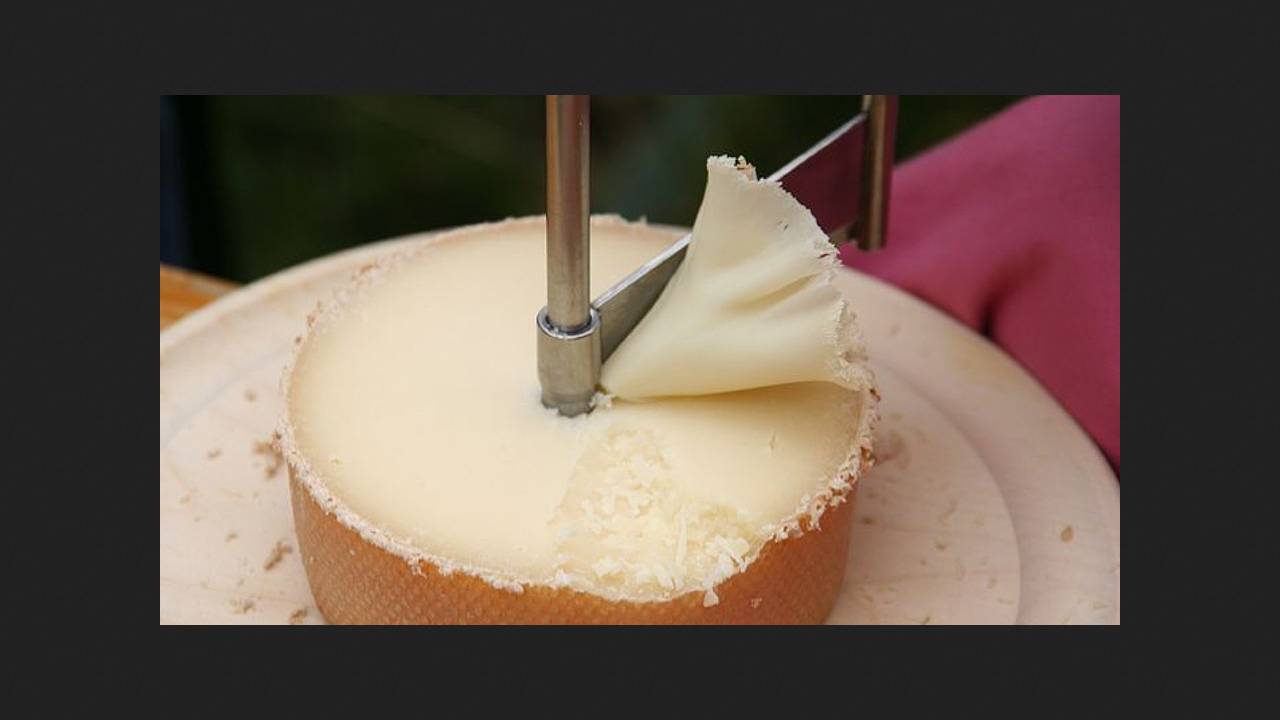
The traditional way to serve tête de moine cheese is as follows: the cheese is skewered on a steel rod fixed in the center of a wooden platform, and a blade is mounted on the rod itself—this culinary device is called a girolle. As the cheese rotates, a knife scrapes off a thin layer, turning it into wrinkled sheets—a sort of flower. This presentation is not only aesthetically pleasing but also practical, as the high surface-to-volume ratio intensifies the cheese's flavor and makes the texture more delicate.
From a physics perspective, the most interesting aspect here is the transformation of a flat, uncurved surface into wrinkled structures with a characteristic geometry. Researchers explained a similar effect in rose petals by saying that the curvature of the object prevented the petals from fitting into three-dimensional Euclidean space. And when thin plastic sheets were torn, the cause turned out to be different: irreversible plastic stretching dramatically increased the length of lines parallel to the boundary as they approached the free edge. However, to date, no one has determined the physical mechanism responsible for the formation of cheese flowers.
Matteo Ciccotti from Sorbonne University, together with colleagues from France, discovered that the wavy structure of cheese leaves arises as a result of changes in the coefficient of friction along the radius of the cheese wheel.
To do this, the physicists assembled a cheese grater with a constant rotation speed of 1.14 radians per second and controlled pressure force during blade-to-blade contact. To ensure reproducible results, the researchers used the same brand of cheese, aged between three and six months, purchased from a single vendor. First, the scientists measured how the length of the outer arc of the cheese flower changed compared to its pre-scraping length: for this purpose, the physicists marked two straight radial lines on the cheese, forming an angle of 15 degrees. They also determined Young's modulus, yield strength, the coefficient of friction between the cheese and the blade, and the fracture energy as a function of the distance to the edge.
As a result, the ratio of the arc length of the cheese flower to the cheese before cutting with a knife showed a nonlinear decrease as one approached the center of the head: initially, this parameter changed from approximately 0.8 to 0.4 as the distance from the edge decreased from zero to ten millimeters, and then became constant at around 0.3-0.4 units. Based on this, the physicists drew two conclusions. First, the distance of 10 millimeters from the edge, at which the measured ratio plateaued, coincided with the thickness of the cheese's boundary layer, which is affected by the drying process. Second, the curvature of the edges was a consequence of the change in spatial metrics, since otherwise (if the arc length ratio decreased over the entire radius of the head), the cheese flowers would have had zero Gaussian curvature and would have remained flat.
The scientists linked the transformation of the spatial metric to the friction coefficient, which showed a smooth change along the radius of the cheese wheel: due to a noticeable gradient, the blade deformed the top layer of the cheese differently. Meanwhile, other mechanical properties—Young's modulus, yield strength, and fracture energy—had virtually no effect on flower formation. Fracture energy, however, became an important factor, but for a different reason: it was high enough to trigger a transition to plastic shear, without which the spatial metric change would not have occurred. The authors also noted that their results will be useful in metal cutting, where a controlled friction coefficient between the blade and the material can be used to achieve the desired chip shape.
This isn't the first time physicists have investigated the seemingly obvious mechanical properties of food: for example, we've already written about how experimenters subjected Oreo cookies to a laboratory twisting test.
