

I've previously written about drugs like piracetam, phenibut, and modafinil—examples of which are used by people all over the world to enhance their mental and physical abilities. There are even entire Reddit threads where "biohackers" gather and discuss the effects of these nootropics, and frankly, back in the days of forums, I was one of them too.
I was inspired to search for such drugs by the film " Limitless, " in which the main character, a loser, becomes smarter thanks to the fantastic drug NZT-48, which improves his memory, concentration, thinking speed, etc. If you haven't seen it, I highly recommend it; it's probably my favorite movie of all time.
The film is certainly fictional, but it does a great job of showing the path to success through improving your body's abilities, and your brain in particular. The functioning of this organ defines us; we are our brain, and only then everything else.
After watching the film, I wondered if there really are substances that do even a little bit of what was shown in the film (I'm not talking about drugs :)). And if you only knew how many experiments I conducted on myself to figure this out—different types of racetams (for example, phenylpiracetam and pramiracetam), phenibut and modafinil, and even mild acetylcholinesterase inhibitors. I've probably already written about this here, but I didn't mention which of these are my top picks.
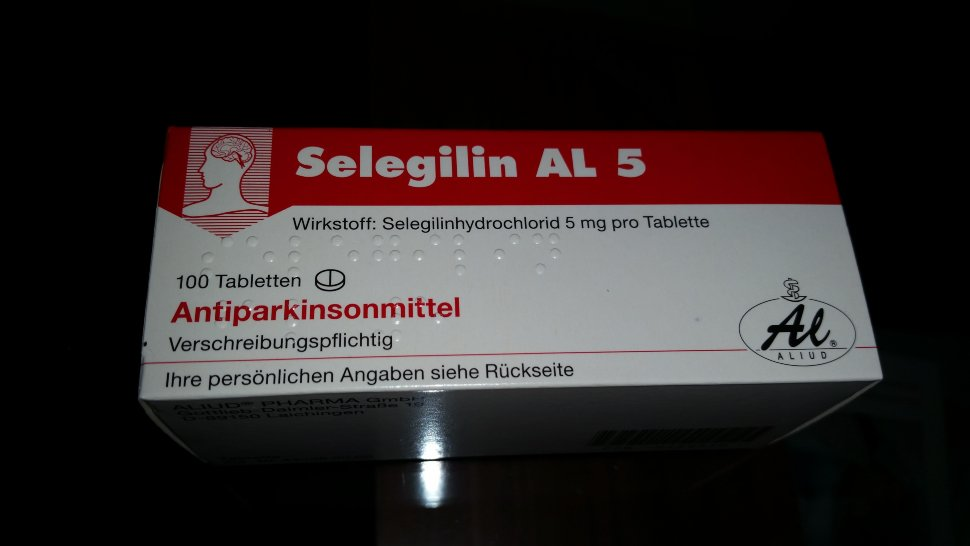
The drug turned out to be Selegiline . It's an inhibitor of MAO-B , the enzyme that metabolizes dopamine (used to treat Parkinson's disease). Inhibiting MAO-B leads to increased levels of neurotransmitters in brain tissue, including dopamine levels in the striatum.
Without going into details, I'll say that this drug was picked up by biohackers after its creator (Jozsef Knoll) claimed it increased lifespan. While that's certainly dubious, he took it for 22 years continuously in mini-doses (1 mg per day) and lived to be 93.
There's no scientific basis for this, but there are studies showing the drug's benefits for brain cells and its protection from oxidative stress. There are also other issues that led to the drug's ban in Russia (interesting metabolites in the body).
My experience with it isn't as great as this person's, because I use it rarely and at a dose of 2.5 mg per day (sublingually), but the effect on cognitive abilities is definitely there and it's quite clear.
Firstly, I've noticed an improvement in my ability to recall words from foreign languages. This was previously a problem for me; communicating in other languages was difficult, and I had some dyslexia in general. Now, thanks to this medication (and perhaps others before it), these problems are reduced. Furthermore, the medication definitely increases motivation and suppresses drowsiness, but caution is needed here; combining it with caffeine and other substances can increase the effects to the point of harm (insomnia, anxiety).
And finally, the memory effect, which manifests itself in the fact that you casually recall stories from the past that seem to have no value, such as where you were, who you talked to, who you saw, etc. Perhaps this effect is just a peculiarity of mine, but it is valuable if you want to analyze something after the fact.
In short, I'd like to warn all readers once again: I'm not encouraging you to take anything (especially if you have conditions you don't understand), but I'm simply sharing information for educational purposes. Perhaps my personal experience will be useful for someone else's research.
You can read a review publication about selegiline here:
https://pmc.ncbi.nlm.nih.gov/articles/PMC7242272

