
Paleoanthropologists have discovered a well-preserved femur, tibia, and partial pelvis in Swartkrans belonging to a young adult, a robust Australopithecus that lived between 2.3 and 1.7 million years ago. These valuable postcranial fragments revealed that this South African Paranthropus from the "Cradle of Humankind" walked primarily bipedally and was extremely small in size—apparently barely more than one meter tall and weighing 27 kilograms. Furthermore, as reported in a paper published in the Journal of Human Evolution, it appears that this individual was preyed upon by a predator—possibly an ancient leopard.
In South Africa, near Johannesburg, lies the so-called Cradle of Humankind, a group of sites listed as a UNESCO World Heritage Site, which is primarily well known for its numerous fossil remains of various hominins: Australopithecus, Paranthropus, and extinct representatives of the genus Homo.
One of the most famous sites in this area is Swartkrans Cave, whose exploration began in the mid-20th century. Over the past decades, scientists have discovered numerous teeth, skull fragments, and even nearly complete skulls and jaws of ancient hominins at this site: African Australopithecus (A. africanus), early Homo, and the robust Paranthropus (P. robustus). However, postcranial bones are not as common there as scientists would like. Moreover, the postcranial skeleton of Paranthropus (including the East African species) remains poorly studied due to the very few known fossils that could be reliably linked to these hominins.
But the work continues, and this time, Travis Rayne Pickering of the University of Wisconsin-Madison, along with colleagues from Germany, the United States, and South Africa, described the results of further studies of materials from Swartkrans. Several years ago, scientists at this site extracted breccia fragments of varying sizes from a layer formed between 2.3 and 1.7 million years ago, and then carefully sorted the rock in the laboratory, yielding the results.
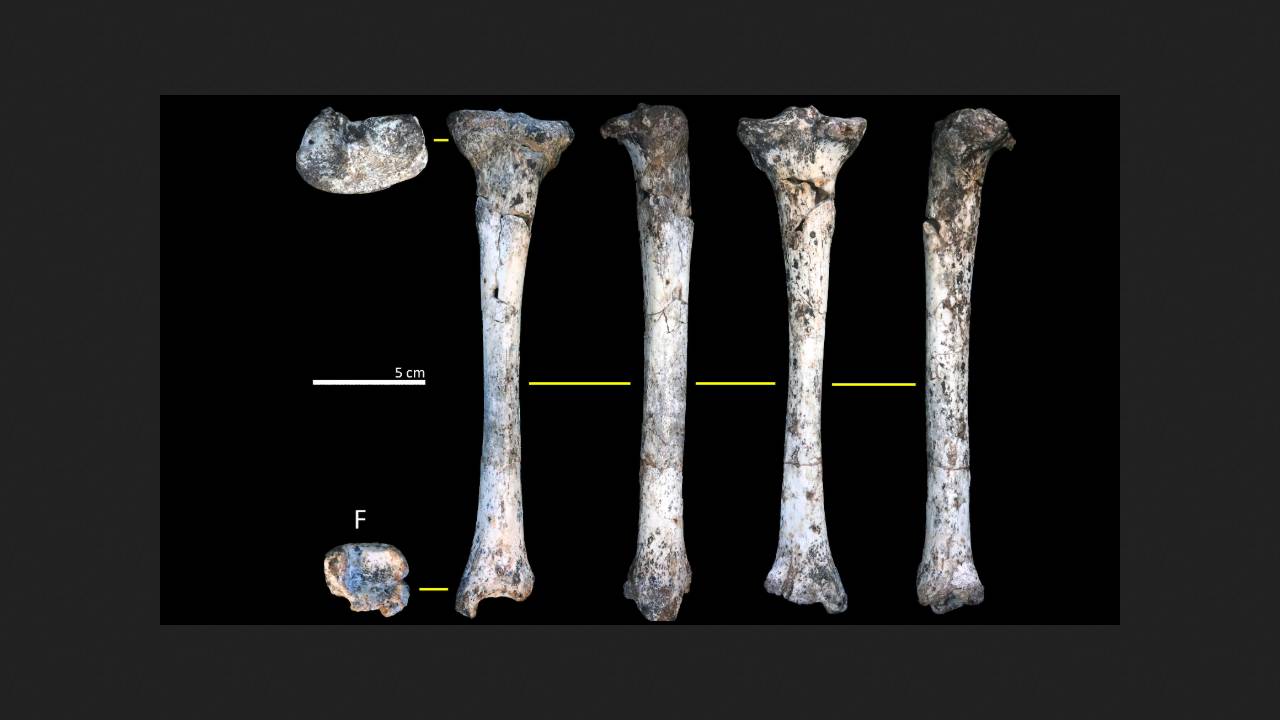
In the rock, researchers found fossilized bones that likely belonged to a single ancient individual, designated SWT-1/HR-2b. According to paleoanthropologists, these are likely the remains of a young adult of the robust Paranthropus (P. robustus). The scientists obtained a nearly complete femur and tibia, as well as a portion of a left pelvic bone, the latter two of which were nearly articulated.
After examining these finds, scientists made several interesting observations. First, the bone structure suggests that the massive Paranthropus individuals were adapted to bipedal walking on hard surfaces, although this does not rule out the possibility that they could have climbed trees if necessary. Second, paleoanthropologists estimated the probable height and weight of this hominin at approximately 103 centimeters and 27.4 kilograms, respectively—roughly the same as those of the known fossil dwarf humans (H. floresiensis) from Flores Island. For comparison, the estimated height of Ardipithecus ramidus and Australopithecus afarensis, according to scientists, was approximately 118 and 110 centimeters, with body weights of approximately 32.1 and 26 kilograms, respectively. Moreover, in the case of the massive Paranthropus from Swartkrans, it remains unclear whether these remains belonged to a male or a female.
Furthermore, the researchers noted damage on the Paranthropus bones they examined, suggesting it likely fell prey to a medium- or large-sized predator. According to the scientists, it's entirely possible that the small hominin was attacked by an ancient leopard, whose prey size class it fell within. Remarkably, in the same breccia layer where the remains of this Paranthropus were found, the scientists also discovered a complete leopard (Panthera pardus) skull.
Many years ago, a skull fragment belonging to an ancient hominin was discovered in Swartkrans. It was apparently killed by a leopard approximately 1.9–1.8 million years ago. Scientists recently reexamined this fossil and concluded that it likely belonged to Homo erectus (H. erectus), not the massive Paranthropus, as had long been believed.
