
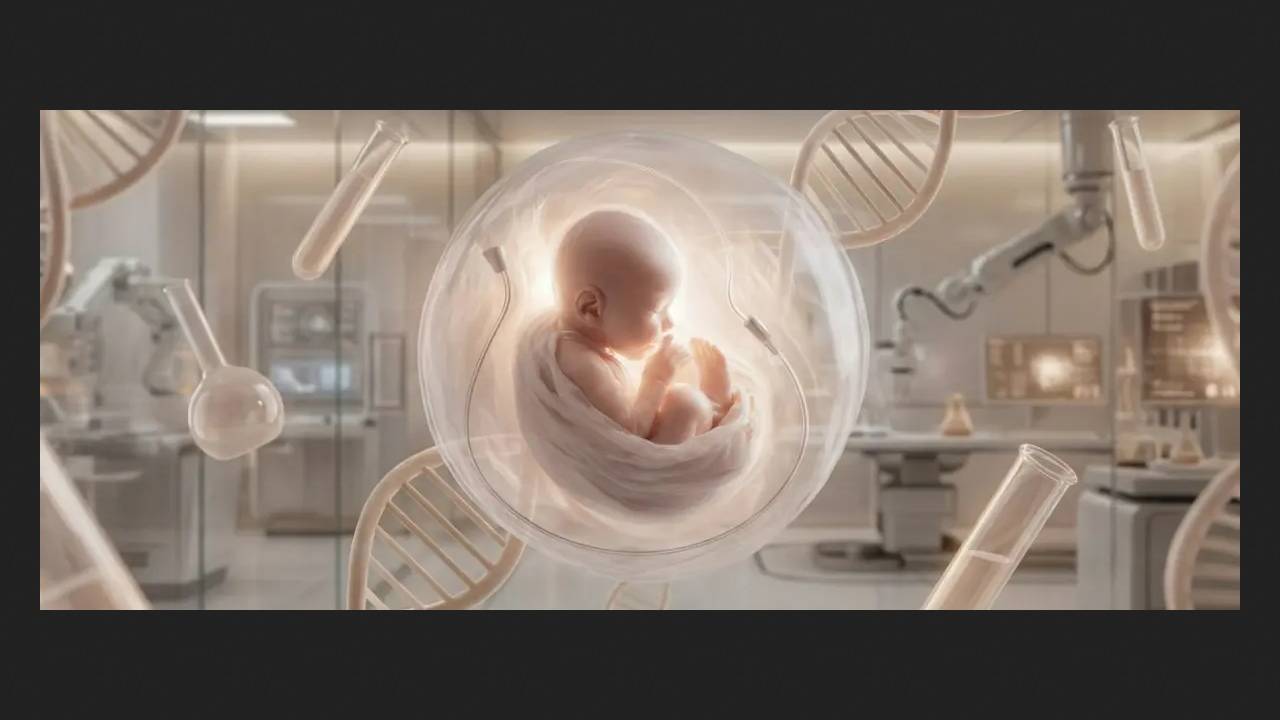
Embryo implantation is a crucial stage of pregnancy, occurring a few days after fertilization. The embryo, 5-6 days old at this point, reaches the uterus, attaches to the uterine lining, and implants into the tissue to develop further. Errors at this stage are a common cause of IVF failure, even if the embryo itself is completely healthy.
Studying implantation in humans is challenging. Ethical restrictions prevent experiments with natural embryos, and early pregnancy tissue can only be obtained through rare medical procedures, such as hysterectomy (removal of the uterus).
Existing laboratory models, such as flat cell cultures or endometrial organoids, are unable to reproduce the complex three-dimensional interaction of the embryo with the uterus.
Researchers from the Chinese Academy of Sciences decided to change this situation and created a mini-uterus on a chip—a 3D model of the endometrium that allows for the reproduction of all key stages of embryo attachment and early development after implantation under controlled conditions.
To do this, endometrial cells were placed in a gel, where they formed a structure as close as possible to the natural mucosa. This tissue, known as endometrioid, was placed on a microfluidic chip, which mimics the movement of nutrients and fluid, creating conditions similar to the uterus. As a result, the tissue functioned as it would in the body, not as if it were in a petri dish. Furthermore, the endometrial cells for the model could be obtained from a single biopsy, and the system also worked with cells collected non-invasively, such as from menstrual blood.
Once the artificial uterine lining was ready, the team placed two types of embryos onto the chip. The first was a true human blastocyst, consisting of 100–200 rapidly dividing cells. The second was blastoids, laboratory-created structures made from stem cells that mimic natural blastocysts. They can be mass-produced while maintaining stable genetic properties.
Experiments showed that the embryos went through a full implantation cycle: they came into contact with the tissue, became attached via molecular signals, and were implanted into the mucosa.
When using cells from women with unsuccessful IVF treatments, embryo implantation was poorer, reflecting real-world clinical observations. Furthermore, over 1,000 FDA-approved drugs were tested on the chip, identifying substances that increase the likelihood of implantation.
This development opens new possibilities for studying the causes of infertility, customizing IVF treatments, and testing drugs in safe and ethical conditions. Future developments include adding blood vessels and immune cells to the model to more accurately replicate human biology.
