
Scientists have examined the remains of an ascetic monk bound in "chains," whose burial was excavated in Israel several years ago. The researchers analyzed the proteins in the man's tooth enamel and concluded that the fifth-century AD tomb likely contained a woman who tormented herself with iron chains. The article was published in the Journal of Archaeological Science: Reports.
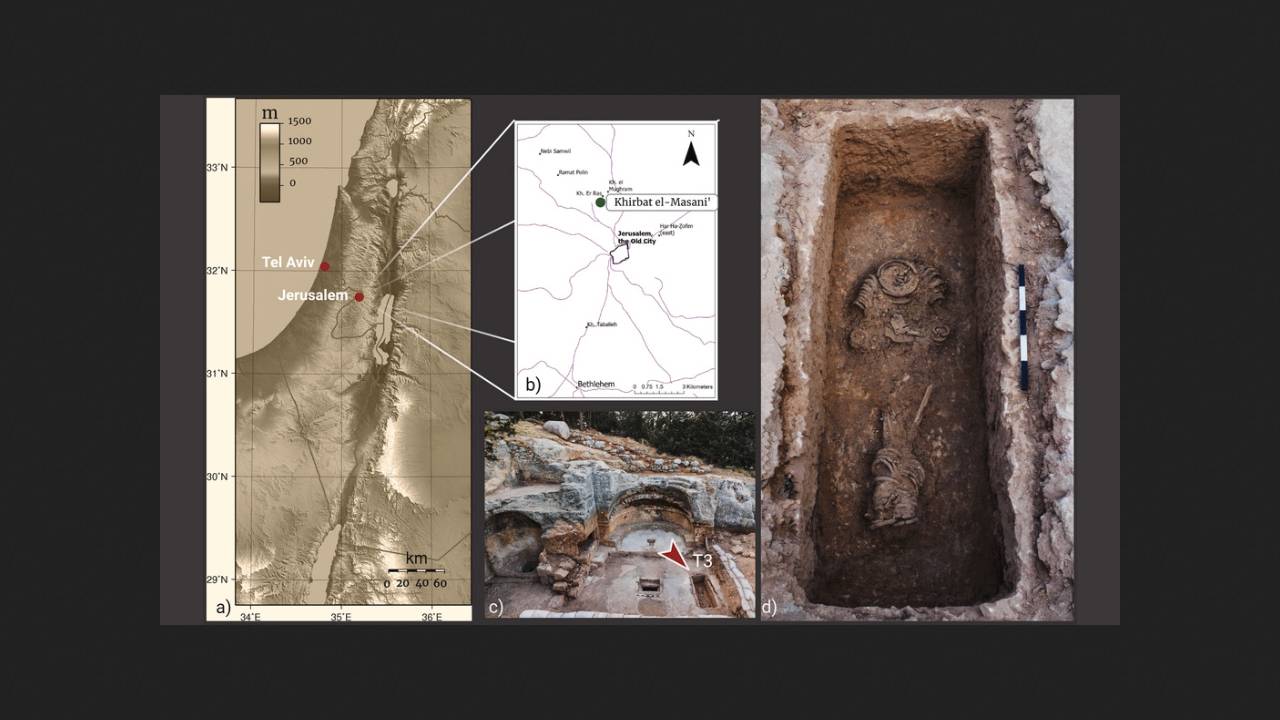
In East Jerusalem, a few kilometers from the Old City, lies the site of Khirbat el-Masani, where archaeologists have uncovered the remains of a Byzantine monastery that existed between 350 and 650 CE. During recent excavations at this site, researchers discovered several burials, likely dating back to the 5th century CE. In one of these tombs, they found the poorly preserved remains of a man buried in chains—heavy iron objects worn by ascetic monks to restrain the body. At the site of the man's neck, arms, and legs, the scientists discovered numerous large metal rings, approximately ten centimeters in diameter and weighing several dozen kilograms.
The skeleton of this ascetic monk has survived to this day in a very fragmentary state, with the few remaining bones literally crumbling when touched. Nevertheless, Paula Kotli of the Weizmann Institute of Science, together with Israeli colleagues, conducted an examination of these remains. Three preserved cervical vertebrae and one tooth allowed us to determine that the burial belonged to an adult, likely between 30 and 60 years old at death.
To determine the individual's gender, scientists used peptide analysis of the enamel of the only remaining tooth—a second premolar in the upper jaw. They found that the sample lacked peptides specific to the AMELY protein, the coding gene for which is located on the Y chromosome. Instead, they detected a significant amount of peptides for the AMELX protein, the gene for which is located on the X chromosome. This led them to conclude that the tomb, dating from the late antique period, likely contained the remains of a woman.
According to researchers, it is known that women in the Roman Empire practiced asceticism at least as early as the 4th century AD. Moreover, famous aristocratic women, such as Melania the Elder, a Christian saint who came from a wealthy noble family, and her granddaughter, Melania the Roman, practiced self-denial to achieve spiritual goals. However, the burial, the study of which the researchers devoted a new article, still attracts attention, as it is the first archaeological evidence that in Byzantium at that time, women, not just men, engaged in self-torture through the wearing of heavy chains.
Proteins can persist in tooth enamel much longer than DNA. Therefore, scientists are increasingly turning to their analysis when studying ancient remains. For example, N+1 previously reported how researchers used the ratio of amelogenin isoforms in tooth enamel to determine the sex of hominins who lived in South Africa more than two million years ago.
